Lead poisoning causes irreversible neurological damage to children. Reduced IQ, learning disabilities, and developmental delays last a lifetime. If your child was exposed to lead paint in a Queens apartment or building, you need a Queens lead poisoning lawyer who understands NYC's strict landlord liability laws and knows how to pursue compensation from those responsible. At The Orlow Firm, our attorneys have recovered millions for lead-poisoned children and their families from our main office in Flushing since 1981.
Call (646) 647-3398 for a free consultation | Se Habla Español

What's in this video?
The Orlow Firm attorneys explain New York City's lead paint laws and what landlords are required to do to protect tenants, especially children, from dangerous lead exposure.
New York City has strict lead paint laws that go beyond federal requirements. These laws matter for your case because they create legal duties that make landlords responsible when children are harmed.
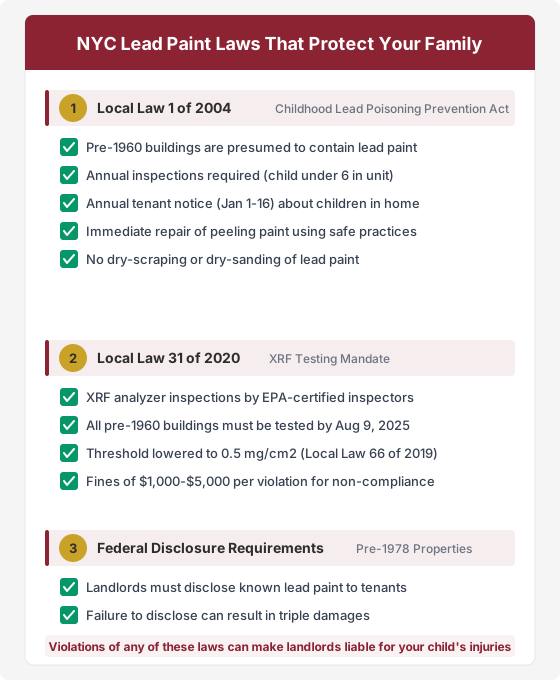
NYC Local Law 1 of 2004 (Childhood Lead Poisoning Prevention Act)
This law presumes that all buildings built before 1960 contain lead-based paint. That presumption matters because a landlord cannot claim they didn't know about lead in their building. The law assumes it's there. Under Local Law 1, landlords of pre-1960 buildings must:
- Conduct annual inspections for lead paint hazards in any unit where a child under age 6 resides or spends 10 or more hours per week
- Provide tenants with an annual notice between January 1 and January 16 asking whether a child under 6 lives in the apartment
- Immediately fix any peeling paint, deteriorated surfaces, or lead dust using safe work practices
- Never dry-scrape or dry-sand lead paint, and ensure trained workers clean work areas daily with wet mops and HEPA vacuums
When landlords violate these requirements, they can be held liable for the injuries their negligence causes.
Local Law 31 of 2020 (XRF Testing Mandate)
Local Law 31 requires landlords to have all dwelling units and common areas inspected by EPA-certified inspectors using XRF analyzers. These are specialized machines that detect lead beneath layers of paint. All pre-1960 buildings must be tested by August 9, 2025. Local Law 66 of 2019 lowered the threshold for what counts as lead-based paint from 1.0 mg/cm² to 0.5 mg/cm². This change makes it easier to identify dangerous levels. Landlords who fail to comply face Class "C" violations carrying fines of $1,000 to $5,000 per violation.
Federal Disclosure Requirements
Federal law requires landlords and sellers of pre-1978 properties to disclose any known lead paint to prospective tenants or buyers. A landlord who fails to provide this disclosure can be liable for triple damages under 42 U.S.C. § 4852d.
These layers of federal, state, and city regulation create a strong legal framework for holding landlords responsible. A Queens lead paint poisoning lawyer at our firm has worked with these laws through multiple legislative changes over the past four decades.
View text version of this infographic
NYC Lead Paint Laws That Protect Your Family
1. Local Law 1 of 2004 (Childhood Lead Poisoning Prevention Act):
- Pre-1960 buildings are presumed to contain lead paint
- Annual inspections required (child under 6 in unit)
- Annual tenant notice (Jan 1-16) about children in home
- Immediate repair of peeling paint using safe practices
- No dry-scraping or dry-sanding of lead paint
2. Local Law 31 of 2020 (XRF Testing Mandate):
- XRF analyzer inspections by EPA-certified inspectors
- All pre-1960 buildings must be tested by Aug 9, 2025
- Threshold lowered to 0.5 mg/cm2 (Local Law 66 of 2019)
- Fines of $1,000-$5,000 per violation for non-compliance
3. Federal Disclosure Requirements (Pre-1978 Properties):
- Landlords must disclose known lead paint to tenants
- Failure to disclose can result in triple damages
Violations of any of these laws can make landlords liable for your child's injuries.
Who Is Liable for Lead Poisoning in Queens?
Identifying every responsible party is important for pursuing compensation. Lead poisoning cases in Queens often involve multiple defendants. An experienced Queens lead poisoning lawyer can investigate all potential sources of liability.
Landlords and property owners are the most common defendants. Under Local Law 1, pre-1960 buildings are presumed to contain lead paint. Landlords have a legal duty to inspect and fix hazards whether or not they had actual knowledge of specific lead problems. Constructive knowledge (what they should have known through proper inspections) is enough to prove liability.
Property management companies that share maintenance duties can also be held liable. If a management company was responsible for building upkeep and failed to address lead hazards, they share in the negligence.
Contractors and renovation companies can create dangerous lead dust when they disturb lead paint during renovation work without following EPA lead-safe work practices. Improper sanding, scraping, or demolition in pre-1960 buildings can release lead particles throughout an apartment.
NYC Housing Authority (NYCHA) operates public housing throughout Queens. Claims against NYCHA require a notice of claim filed within 90 days, a much shorter deadline than the standard statute of limitations. Missing this deadline can cost you your right to compensation entirely.
Day care and school operators may be liable if their premises contain lead hazards that expose children. Under New York law, multiple defendants can be held jointly and severally liable for economic damages such as medical expenses and lost earnings, meaning you can recover the full amount of economic damages from any responsible party. For non-economic damages like pain and suffering, defendants found less than 50% at fault may have their share limited under CPLR Article 16.
Our $5 million verdict involved an infant in a foster home with lead paint. It shows our experience with cases involving non-traditional defendants for lead exposure.
Health Effects of Lead Poisoning in Children
The CDC states there is no known safe level of lead in a child's blood. Even low levels of exposure can cause permanent neurological damage. Lead interferes with brain development during the most important growth years.

What's in this video?
The Orlow Firm discusses the serious and often permanent health consequences that lead poisoning causes in children across New York, including cognitive and developmental impacts.
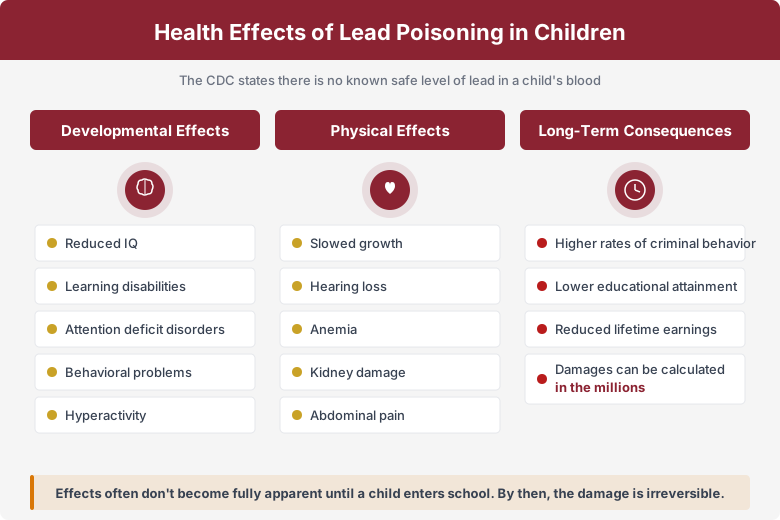
Developmental effects include reduced IQ, learning disabilities, attention deficit disorders, hyperactivity, and behavioral problems. These impairments often don't become fully apparent until a child enters school. By that point, the damage is irreversible.
Physical effects include slowed growth, hearing loss, anemia, kidney damage, and abdominal pain. Children may show irritability, loss of appetite, fatigue, and weight loss.
Long-term consequences extend into adulthood. Adults who were lead-poisoned as children face higher rates of criminal behavior, lower educational attainment, and reduced lifetime earnings. These damages can be calculated in the millions.
Adults can also be exposed through construction work, renovation projects, and occupational settings. Workers who disturb lead paint without proper protection may have both workers' compensation and third-party liability claims.
View text version of this infographic
Health Effects of Lead Poisoning in Children
The CDC states there is no known safe level of lead in a child's blood.
Developmental Effects:
- Reduced IQ
- Learning disabilities
- Attention deficit disorders
- Behavioral problems
- Hyperactivity
Physical Effects:
- Slowed growth
- Hearing loss
- Anemia
- Kidney damage
- Abdominal pain
Long-Term Consequences:
- Higher rates of criminal behavior
- Lower educational attainment
- Reduced lifetime earnings
- Damages can be calculated in the millions
Effects often don't become fully apparent until a child enters school. By then, the damage is irreversible.
If your child shows signs of developmental delay, learning difficulty, or behavioral changes and you live in an older Queens building, request a blood lead test from your pediatrician right away. Early detection can help reduce some effects through chelation therapy and ongoing medical care.
View text version of this infographic
What to Do If Your Child Has Elevated Lead Levels:
- Contact Your Pediatrician - Get a treatment plan; chelation if levels are high
- Report to NYC Dept. of Health - They will investigate the exposure source
- Document Everything - Test results, apartment conditions, landlord letters
- Call a Lead Poisoning Lawyer - Protect your child's legal rights
Key Deadlines to Know:
- 90 Days: Notice of claim for NYCHA properties (strict deadline)
- 3 Years: Statute of limitations (adults)
- Minors: Tolled until age 18, then 3 years
Why Act Quickly?
- Landlords may renovate apartments
- Maintenance records can be destroyed
- Properties may be sold
- Witnesses become harder to locate
Free consultation: (646) 647-3398
Compensation for Queens Lead Poisoning Cases
Lead poisoning cases often result in large compensation because the injuries are lifelong and the costs are enormous. Our firm has a strong record in these cases:
$5,000,000 -- Infant in foster home with lead paint; extremely elevated blood lead levels resulting in neurological problems
$3,750,000 -- Child with elevated lead levels due to landlord and maintenance company negligence
$2,000,000 -- Child with elevated lead levels caused by landlord's failure to maintain apartment
$450,000 -- Infant in foster home with lead paint; neurological problems
$425,000 -- Brother and sister with elevated blood lead levels in the same building
Prior results do not guarantee a similar outcome.

What's in this video?
The Orlow Firm explains how landlord negligence in maintaining lead-safe properties has led to million-dollar recoveries for children harmed by lead paint exposure.
New York law allows lead poisoning victims to recover compensation for:
- Medical expenses -- Blood testing, chelation therapy, ongoing monitoring, specialist care, and future medical needs
- Special education costs -- Many lead-poisoned children require IEPs, specialized schooling, tutoring, and educational support throughout their academic careers
- Developmental therapy -- Speech therapy, occupational therapy, and behavioral therapy can continue for years
- Pain and suffering -- Physical and emotional distress from both the exposure and its lifelong consequences
- Lost future earning capacity -- Reduced IQ and cognitive impairment limit lifetime earnings, and expert economists can calculate these losses
- Parental counseling and support costs -- Families often need counseling to manage the ongoing challenges of raising a lead-affected child
These damages add up quickly. A child with a 10-point IQ reduction from lead exposure will earn far less over a lifetime. Those losses can be measured in the millions of dollars.
Statute of Limitations for Queens Lead Poisoning Cases
New York has a three-year statute of limitations for personal injury claims. Lead poisoning cases have special timing rules that families need to understand.
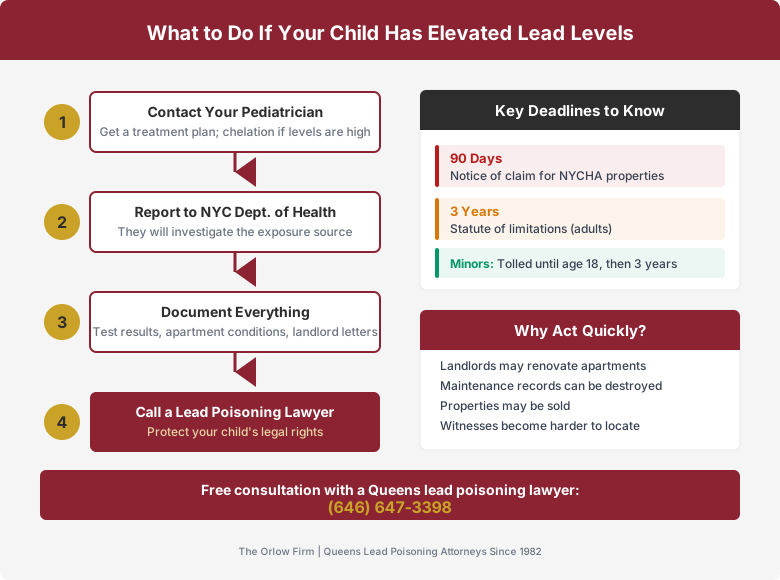
Minors tolling: The statute of limitations is paused for children until they turn 18. Once a lead-poisoned child reaches age 18, they have three years to file a lawsuit. This effectively extends the deadline until age 21.
Discovery rule: Because lead poisoning effects may not become apparent for years, the clock may start when the injury is discovered or reasonably should have been discovered, rather than when the exposure occurred. This is codified in CPLR § 214-c for latent injuries from toxic exposure.
Government entity claims (NYCHA, city-owned buildings): If your child was exposed to lead in a NYCHA building or other government-owned property, you must file a notice of claim within 90 days under General Municipal Law § 50-e. This is a strict deadline that can bar your case entirely if missed.
Act promptly regardless: Even though the statute extends for minors, evidence degrades over time. Landlords may renovate apartments, destroy maintenance records, or sell properties. The sooner you contact a lead paint attorney in Queens, the better we can preserve the evidence that proves your case.
Lead Poisoning Risks in Queens
Queens presents unique lead poisoning risks because of its housing stock and demographics. A 2017 Reuters investigation found that children in parts of Queens and other NYC areas tested positive for lead poisoning at rates more than double those in Flint, Michigan. That finding drew national attention to the crisis in New York City's older neighborhoods.
About two-thirds of New York City's housing units were built before 1960, when lead-based paint was standard. According to NYC DOHMH data, Queens had 8,238 children under 6 with blood lead levels at or above 5 µg/dL (the reference value used at that time; the CDC lowered this to 3.5 µg/dL in 2021) in 2005. By 2016, that number had dropped to 1,247 — an 86% decline. The rate fell from 102.5 per 1,000 tested children to 14.3. Queens tested between 80,000 and 92,000 children per year during that period.
Despite falling blood lead levels in children, HPD lead-based paint violations in Queens surged from 727 in 2016 to 3,265 in 2024 — a 349% increase. This reflects stronger enforcement, not worsening conditions. Legislative changes including Local Law 31 of 2020 expanded inspection requirements and lowered the threshold for what counts as a lead hazard. Queens violations more than doubled from 2020 to 2024 alone.
Highest-Risk Queens Neighborhoods
Our analysis of NYC HPD violation records shows Ridgewood (zip code 11385) leads all Queens neighborhoods with 3,169 lead-based paint violations, followed by Jackson Heights (11372) with 2,827. Together, these two zip codes account for about 22% of all Queens lead paint violations. The top five zip codes — Ridgewood, Jackson Heights, Elmhurst, Jamaica, and Woodside — account for roughly 40% of all violations borough-wide.
West Queens consistently had the highest childhood blood lead level rates among Queens neighborhoods through 2016, followed by Southwest Queens and Jamaica. Flushing, Astoria, Corona, Richmond Hill, Forest Hills, Long Island City, and Kew Gardens also face elevated risks due to their large pre-war housing stock.
Some buildings are repeat offenders. Our review of HPD records found that 22-88 Mott Avenue in Far Rockaway has accumulated 148 lead-based paint violations — more than any other building in Queens. Jackson Heights alone has four buildings among the top 20 repeat violators. If you live in one of these neighborhoods and suspect lead exposure, getting your child tested is the first step.
In 2023, 5,078 NYC children under 6 were identified with blood lead levels of 3.5 mcg/dL or greater, according to the NYC DOHMH annual report. The city tests close to 300,000 children for lead each year, more than any other U.S. city.
The Orlow Firm's main office is at 71-18 Main Street in Flushing, in the heart of Queens. Steven Orlow served as Counsel to the Queens County Executive and as an NYC Council Member-At-Large representing about two million Queens residents. Adam Orlow served as President of the Queens County Bar Association. This isn't a Manhattan firm reaching into Queens for cases. We are Queens attorneys who have been part of this community for over 40 years.
We offer bilingual services (Se Habla Español) because Queens is one of the most ethnically diverse areas in the world. Many families affected by lead poisoning in Flushing, Queens and surrounding neighborhoods need an attorney who can communicate in their language.
Frequently Asked Questions About Queens Lead Poisoning Cases
How do I find out if my apartment has lead paint?
Request an XRF inspection through your landlord or file a complaint with NYC HPD at 311. Under Local Law 31, landlords of pre-1960 buildings must have all units tested by EPA-certified inspectors. You can also request a free home lead paint inspection through the NYC Department of Health if a child under 6 lives in your home.
What should I do if my child's blood test shows elevated lead levels?
Contact your pediatrician right away for a treatment plan, which may include chelation therapy for high levels. Report the elevated test to the NYC Department of Health, which will investigate the exposure source. Write down everything: test results, apartment conditions, and letters to and from your landlord. Then call a Queens lead poisoning lawyer to protect your legal rights.
Can I file a lead poisoning claim if my child is now an adult?
Yes. New York law tolls the statute of limitations for minors until age 18, giving them until age 21 to file. The discovery rule may extend this further if symptoms or their connection to lead exposure were not reasonably discoverable earlier. Many adults file claims for childhood lead exposure and recover compensation for lifelong cognitive and developmental harm.
What if my landlord has already painted over the lead paint?
Painting over lead paint does not remove the hazard or the liability. XRF testing can detect lead beneath multiple layers of new paint. If the underlying lead paint deteriorates, chips, or creates dust, it remains dangerous. The landlord's duty under NYC law is to properly abate lead hazards, not merely cover them with a fresh coat of paint.
How long does a lead poisoning case take to resolve?
Lead poisoning cases typically take two to four years to resolve. The timeline depends on the severity of injuries, the number of liable parties, whether the case settles or goes to trial, and the time needed to assess the child's developmental impact. Our attorneys work to move cases quickly while protecting your right to pursue all available compensation.
Can undocumented immigrants file lead poisoning claims in New York?
Yes. Immigration status has no bearing on your right to file a personal injury claim in New York. Our firm has deep experience representing undocumented clients in personal injury cases, including construction accidents and lead poisoning claims. We offer bilingual services and New York law does not require disclosure of immigration status in these proceedings.
Sources & Official Resources
NYC Laws Cited
- NYC Local Law 1 of 2004 — Childhood Lead Poisoning Prevention Act
- NYC Local Law 31 of 2020 — XRF Testing Requirement FAQ
- NYC Local Law 66 of 2019 — Lead-Based Paint Threshold
New York State Laws Cited
- CPLR § 214 — Statute of Limitations for Personal Injury
- CPLR § 208 — Infancy Tolling
- CPLR § 214-c — Discovery Rule for Latent Injuries
- CPLR Article 16 — Limited Liability of Persons Jointly Liable
- General Municipal Law § 50-e — Notice of Claim
Federal Laws Cited
- 42 U.S.C. § 4852d — Lead-Based Paint Disclosure Requirements
- EPA Lead-Based Paint Disclosure Rule (Section 1018 of Title X)
Statistics Sources
- NYC DOHMH Annual Report on Childhood Lead Exposure (2024 Report Covering 2023 Data)
- NYC DOHMH Blood Lead Levels in Children Under 6, 2005-2016
- NYC HPD Lead-Based Paint Housing Violations, 1999-2025
Helpful Resources
Data Methodology
Borough and neighborhood breakdowns were calculated by The Orlow Firm's research team from publicly available NYC Open Data records. Blood lead level data (NYC DOHMH, 2005–2016) and HPD lead-based paint violations (1999–2025) are published at the address or neighborhood level. We aggregated these records to produce the Queens-specific statistics cited above, as city agencies do not publish pre-calculated borough-level breakdowns for all metrics.
Contact a Queens Lead Poisoning Lawyer Today
If your child has been exposed to lead paint in a Queens apartment or building, New York law provides strong protections that may support your claim. But you need to act. Evidence can be lost, buildings can be renovated, and strict deadlines like the 90-day notice of claim for NYCHA properties can pass quickly.
The Orlow Firm has protected lead-poisoned children and their families throughout Flushing, Jamaica, Astoria, Jackson Heights, and all of Queens for over 40 years. You'll work directly with a partner, not a junior associate, and you pay nothing unless we win your case.
Call (646) 647-3398 for a free consultation. We can come to you if you cannot come to us.
Se Habla Español | Four NYC office locations | No fee unless we win

What's in this video?
The Orlow Firm attorneys explain why their decades of lead poisoning case experience, Queens roots, and personal approach make them the right choice for families dealing with lead exposure.